Appearance
How ideas work in Marginborn
Most reading apps organise by source: your notes from Atomic Habits live in one place, your highlights from Thinking, Fast and Slow in another. That's useful for reviewing a single book. It's useless for the question that matters most: what have I read, across everything, on the subject of habit?
Marginborn answers that question through ideas — and this article is both the guide to how they work and the full reference for all 97.
The short version
Every note you keep attaches to an idea. The ideas come from a fixed canon of 97 — chosen to match how people actually read non-fiction today — plus any you add yourself. They're arranged in a three-level tree: four broad categories (plus a fifth for your own), eight branches beneath them, and the 97 ideas as leaves at the bottom. You tag and connect notes at the leaf — never at the group. That one rule is what turns a pile of notes into an index of what you've actually thought.
The shape of the tree
Picture it top to bottom.
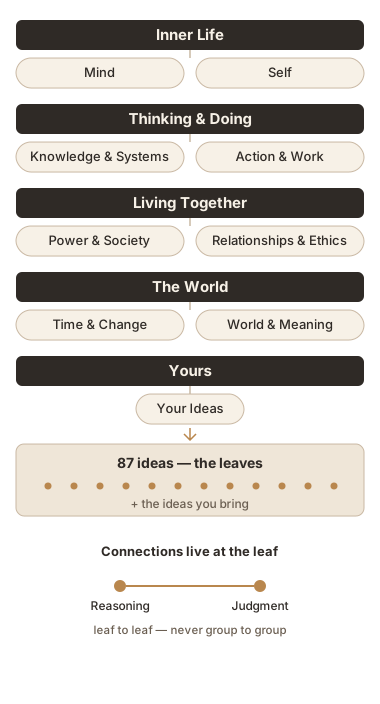
At the top sit four categories, each holding two branches:
- Inner Life — Mind, Self (e.g. Attention, Habit, Purpose)
- Thinking & Doing — Knowledge & Systems, Action & Work (e.g. Evidence, Strategy, Feedback)
- Living Together — Power & Society, Relationships & Ethics (e.g. Justice, Markets, Empathy)
- The World — Time & Change, World & Meaning (e.g. History, Nature, the Sacred)
That's eight branches. Beneath each hang its leaves — the actual ideas you tag. Under Mind you'll find Attention, Memory, and Reasoning; under Power & Society, Justice, Power, and Democracy; under World & Meaning, Nature, Life, and Death. The 97 leaves are the working vocabulary.
A fifth category, Yours, holds a ninth branch — Your Ideas — for anything you create yourself. It only appears once you've made one.
Where the structure comes from
The canon is a curated, contemporary set. Non-fiction today trends toward mindful self-help, historical investigation, expert scenario analysis, and thoughtful memoir — so the working vocabulary leads with the ideas those books actually turn on, rather than the abstract concepts a classics-first index would.
Four lenses organise it. Inner Life is the mind and the self — how we think and who we are. Thinking & Doing is how we know the world and how we act in it. Living Together is power, society, and the ethics of life with others. The World is time, change, and the meaning of what's around us.
Marginborn first shipped a classical canon — the 102 headings of Mortimer Adler's Syntopicon — and this contemporary set descends from it: every classical idea was re-mapped onto its nearest contemporary leaf, so nothing you'd already tagged was lost.
Connections live at the leaf
This is the load-bearing rule, so it's worth being concrete.
Tag one note Reasoning and another Judgment. A connection can form between them because both are leaves under Mind — but the connection is Reasoning-to-Judgment, the two specific ideas, not Mind-to-Mind. Connections always run leaf to leaf. A note on Habit might link to one on Discipline (both under Self) or to one on Learning (under Mind) — wherever the actual ideas meet.
The branch and category nodes never connect to anything. They exist so you can browse — survey a whole category, or see which ideas your reading keeps returning to. They're rollups for the eye, never edges in the graph. This is the line that separates Marginborn from a folder of tags: groups help you look; only leaves carry meaning.
Newer ideas start empty
Some leaves are genuinely new to the canon, with no older idea behind them. They start out empty and fill in as you capture notes that touch them (or as Marginborn re-suggests ideas across your existing notes). That's expected, not a gap.
Bring your own ideas
The 97 cover an enormous amount of ground, but not every thread you're chasing — narrative medicine, stoic practice, a motif you're tracing across one author. For those, make your own.
From your Profile, open Your Custom Ideas and tap +. Give the idea a name (required) and, ideally, a short description — the AI uses it when deciding which notes to suggest the idea for, so a good description improves discovery. Your custom ideas live under the fifth category, Yours, in a single branch called Your Ideas. They behave exactly like the canon: the AI suggests them, they gather notes over time, and they connect at the leaf.
Browsing and tagging
Two different moves, at two different levels.
You tag at the leaf, always. A note attaches to Justice, never to Living Together. Tagging is precise by design — it's what makes the index trustworthy.
You browse at any level. Open a whole category to get the lay of the land, narrow to a branch, or drill straight to a single leaf to read everything you've gathered under it. Browsing is for roaming; tagging is for committing.
The full list
Every one of the 97, grouped by branch, with a one-line definition.
Inner Life
The mind and the self — how we think and who we are.
Mind
- Attention — Focusing awareness; what we notice and what we filter out.
- Memory — Retaining and recalling past experience.
- Learning — Acquiring knowledge or skill through study or experience.
- Reasoning — Drawing conclusions through logic and inference.
- Judgment — Forming considered evaluations and practical decisions.
- Creativity — Generating novel, valuable ideas or work.
- Curiosity — The drive to explore, question, and understand.
- Intuition — Knowing without conscious reasoning; a felt sense.
- Bias — Systematic distortion in perception or judgment.
- Uncertainty — Incomplete knowledge; not knowing what is or will be.
- Expertise — Deep, practiced mastery of a domain.
- Teachability — Active openness to being changed or proven wrong.
Self
- Identity — Who one is; the sense and constitution of self.
- Emotion — Felt affective states such as joy, fear, or anger.
- Motivation — What drives, energizes, and directs action.
- Habit — A settled disposition to act a certain way, built by repetition.
- Discipline — Self-control in the pursuit of goals.
- Anxiety — Apprehension and worry about threat or the future.
- Resilience — Recovering and adapting after adversity.
- Purpose — A sense of direction and meaning in life.
- Authenticity — Being true to oneself.
- Vulnerability — Openness to being hurt, exposed, or affected.
- Desire — Wanting; longing or craving for something.
- Consciousness — Subjective awareness and inner experience.
- Acceptance — Allowing experience as it is; releasing the urge to resist or control it.
- Self-Compassion — Meeting one's own failings with kindness rather than judgment.
- Sufficiency — The inner sense of enough that decouples wellbeing from acquisition.
Thinking & Doing
How we know the world and how we act in it.
Knowledge & Systems
- Truth — Correspondence of belief or statement to reality.
- Evidence — Observations that support, test, or refute a claim.
- Explanation — An account of why or how something is so.
- Language — Systems of words and signs that carry meaning.
- Narrative — Story; meaning organized as sequence.
- Models — Simplified representations used to understand or predict.
- Information — Structured data that reduces uncertainty.
- Complexity — Many interacting parts; hard-to-predict wholes.
- Emergence — Higher-order patterns arising from simpler parts.
- Systems — Interconnected wholes with structure and feedback.
- Causation — One thing bringing about another.
- Probability — The likelihood of uncertain events.
- Understanding — Grasping why and how something is so, beyond merely knowing that it is.
- Externalized Cognition — Thinking carried out through external tools, where the artefact is part of the thought.
Action & Work
- Decision — Choosing among alternatives.
- Strategy — A plan to achieve goals under constraints.
- Risk — Exposure to uncertain loss or harm.
- Mastery — Sustained skill and excellence at a craft.
- Failure — Falling short; not achieving the aim.
- Innovation — Creating and adopting something new of value.
- Feedback — Outputs looping back to adjust a system.
- Incentives — Rewards and penalties that shape behavior.
- Leadership — Guiding and influencing people toward ends.
- Collaboration — Working together toward shared goals.
- Productivity — Output achieved per unit of effort or time.
- Decision Quality — Judging a choice by the quality of its reasoning, not the luck of its result.
- Positioning — Arranging circumstances in advance so good outcomes need no heroics; buffers and options.
Living Together
Power, society, and the ethics of life with others.
Power & Society
- Justice — Giving each their due; fairness in our relations and institutions.
- Freedom — Absence of coercion; the capacity to act.
- Equality — Equal standing, rights, or treatment.
- Power — The capacity to influence or compel.
- Authority — Legitimate, recognized power.
- Institutions — Enduring rules and organizations of society.
- Markets — Systems of exchange, price, and trade.
- Inequality — Uneven distribution of resources or status.
- Democracy — Collective self-rule by the people.
- Trust — Confident reliance on others.
- Status — Relative social rank, honor, or esteem.
- Conflict — Opposition, struggle, or war between parties.
- Cooperation — Acting together for mutual benefit.
- Representation — The power to portray others, and to grant or deny them a complex identity.
- Restitution — Repairing a past wrong by returning what was taken; justice that looks backward.
Relationships & Ethics
- Love — Deep affection and attachment.
- Friendship — Voluntary bonds of mutual affection.
- Community — Belonging within a shared group.
- Care — Attending to the needs and wellbeing of others.
- Empathy — Feeling and understanding another's experience.
- Obligation — Duty; what one is bound to do.
- Morality — Principles of right and wrong conduct.
- Virtue — Excellence of character.
- Forgiveness — Releasing resentment for a wrong.
The World
Time, change, and the meaning of the world around us.
Time & Change
- Time — Duration, sequence, and the passage of moments.
- Change — Becoming different over time.
- Progress — Change toward improvement.
- History — The recorded past and its study.
- Growth — Increase, development, or maturation.
- Entropy — Tendency toward disorder and dissipation.
- Cycles — Recurring patterns and rhythms.
- Future — What is yet to come.
World & Meaning
- Nature — The physical world and its order.
- Life — Living things; the state of being alive.
- Evolution — Change in living forms across generations.
- Energy — The capacity to do work; physical power.
- Beauty — Aesthetic value that delights perception.
- Art — Creative expression and its works.
- Play — Free, intrinsically rewarding activity.
- Wonder — Awe before the vast or mysterious.
- Suffering — Pain and distress.
- Death — The end of life.
- the Sacred — The holy; what is set apart for reverence.
Yours
Your Ideas
The 97 above are fixed. Your Ideas is where everything you add yourself lives — a single branch under the Yours category, holding the custom ideas you create from your Profile. They aren't listed here because they're yours and they grow over time, but they sit in the tree exactly like the canon and connect at the leaf in exactly the same way. See Bring your own ideas above for how to make one.
Next: Your Library — connecting every note to the book or article it came from.